Model · 500 Series · 1987–2003
Sub-Zero 500 Series Repair in Ponte Vedra
The 532, 550 and 561 outlived their installers and most of their kitchens. Kept properly, they outlive their replacements too.
Sub-Zero Repair Ponte Vedra repairs Sub-Zero 500 series classics across Ponte Vedra Beach and the 32082 ZIP — call (904) 902-0927 or use the online booking page. These 1987–2003 units fail at the sealed system first: evaporator leaks frost only part of the coil, and a full evaporator-and-heat-exchanger repair near $2,500 still beats a built-in replacement starting around $14,000.
For Sub-Zero repair across Ponte Vedra Beach — Sawgrass, Marsh Landing and the oceanfront — call (904) 902-0927 or Book online.
What You Own
The 500 Series Lineup, and Why It Endures Here
Sub-Zero® built the 500 series from 1987 to 2003: the 532 forty-eight-inch side-by-side, the 542 at forty-two inches, the 550 over-under thirty-six, and the 561 bottom-mount that ran latest of all, to 2003. Old Ponte Vedra, Sawgrass and Marsh Landing largely went up in exactly that window, so an enormous share of the refrigeration we open in those kitchens is original — units now well past thirty years of service and still, mechanically, sound.
That endurance is the whole point. These were engineered for two decades and more, and the compressors and condensers in a well-maintained 532 are often the last things to fail. What does wear out is predictable, nameable, and — this matters — repairable for a fraction of what a replacement built-in costs once you add cabinetry and millwork.
The Three Failures That Define a 500 Series Call
Evaporator refrigerant leaks
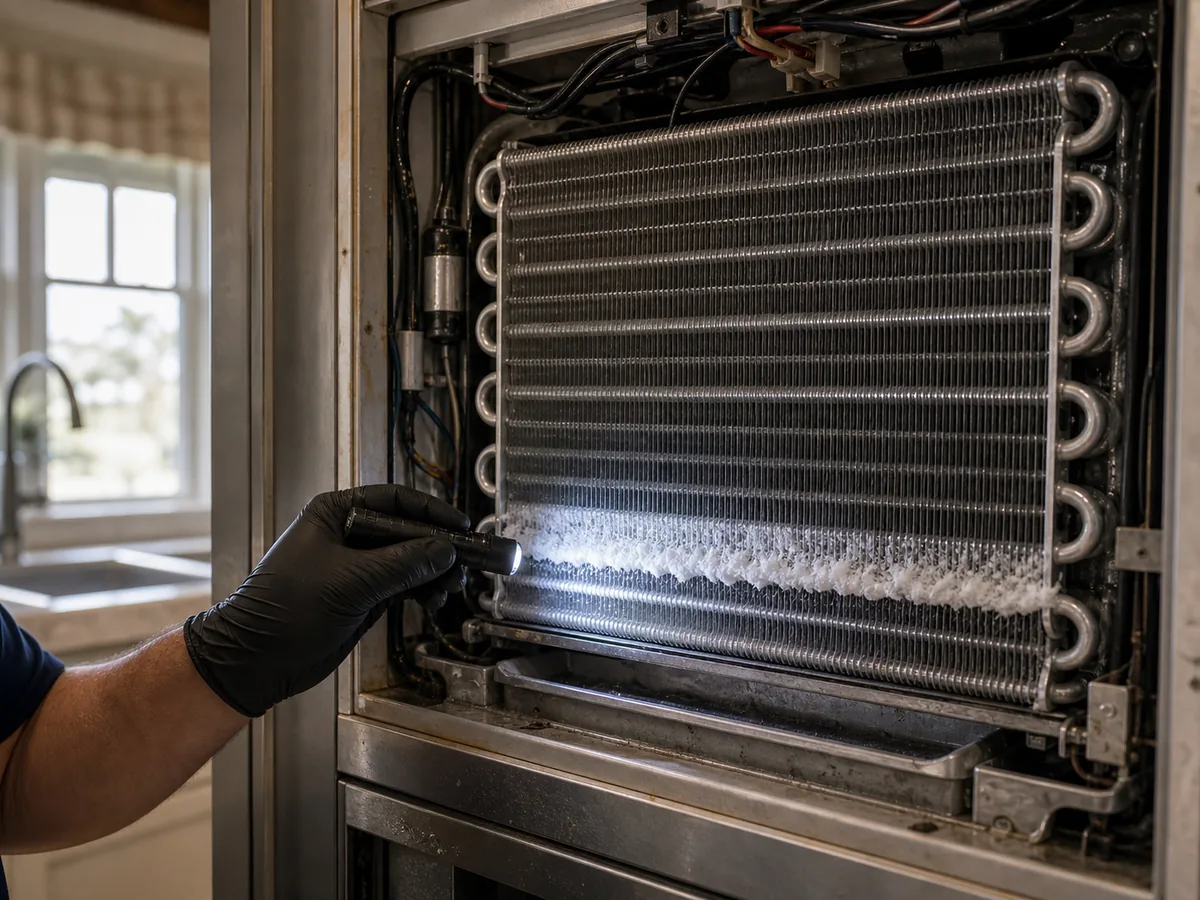
This is the headline failure, and the 561's refrigerator-side coil is the worst offender. A slow leak drops the charge until the evaporator can only frost its first four to eight inches; the unit runs constantly, never quite cools, and an owner reasonably fears the compressor. The compressor is usually fine. We read the frost pattern, confirm with gauges, and move it to the sealed-system bench only with the evidence attached.
Defrost-drain icing
Five thousand defrost cycles leave residue, and the drain line scales shut. Meltwater backs up into a sheet of ice under the basket, then finds the floor. It looks alarming and costs little — a clearing and re-route in the $250–$550 lane. It is the repair we most enjoy giving, because the news is good.
Hardened gaskets and tired controls
Within reach of the ocean a door gasket stiffens in three or four years; a leaking seal taxes the compressor every hour the unit runs. Fresh seals plus a mechanical cold control that has drifted are the quiet maintenance that keeps a classic honest. The gasket service covers the dollar-bill test worth knowing.
500 Series Repairs and the Ranges to Expect
| 500 series job | What it addresses | Typical range |
|---|---|---|
| Defrost-drain clearing | Ice sheet under basket, water on the floor | $250–$550 |
| Gasket set & cold-control service | Humid-air infiltration, drifting temperatures | $550–$1,100 |
| Compressor replacement | Confirmed mechanical failure, gauges first | $1,000–$2,000 |
| Evaporator & heat-exchanger work | Refrigerant leak on the 561 / 532 coil | $1,500–$3,000 |
One line, one technician, no dispatch queue
(904) 902-0927The Math That Saves the Classic
Here is the decision a 500 series owner faces, stated plainly. A thirty-year-old 532 needing a new evaporator and heat exchanger runs near $2,500 done right. The built-in that would replace it starts around $14,000 before a cabinetmaker touches the surrounding millwork to fit a modern unit's different dimensions. Even allowing for a future compressor down the road, the arithmetic favors repair by a wide margin on a unit whose sealed system and structure are otherwise intact.
The exceptions are real and we name them: a unit that has already had its compressor and evaporator replaced, has a corroded cabinet, or sits in a kitchen slated for a gut renovation changes the equation. The repair-or-replace guide walks the full decision; for the salt-air maintenance that keeps a 500 series out of the expensive failures, the coastal care calendar is the companion read.
The 500 Series Model by Model
The series is not one machine but several, and the differences decide which parts a repair turns on. This is the lineup we open in 32082 kitchens, with the configuration and the year range that pin each one.
| Model | Configuration | Build years |
|---|---|---|
| 532 | 48-inch side-by-side | 1987–1996 |
| 542 | 42-inch side-by-side | 1987–1996 |
| 550 | 36-inch over-under | 1987–1996 |
| 561 | 36-inch bottom-mount | to 2003 (561/O 2001–2003) |
| 501R / 501F | All-refrigerator / all-freezer columns | 1987–1996 |
Per-Model Failure Patterns Worth Knowing
The 561 earns its reputation honestly: its fresh-food-side evaporator is the worst coil in the series for slow refrigerant leaks, and because the 561 ran latest, it is also the unit most likely still in daily service — which is why it accounts for a large share of our sealed-system work. The 532 and 542 side-by-sides carry two sealed circuits and the heaviest doors of the family, so on those the gasket and hinge work matters as much as the refrigeration; a sagging 48-inch door breaks its own seal over time.
The 550 over-under, the volume model of the early run, shows its age first at the defrost drain — thousands of cycles scale the line until meltwater backs up under the basket. The all-column 501R and 501F units, often paired as a his-and-hers set in larger Old Ponte Vedra kitchens, fail one at a time, so we always ask whether a second column shares the kitchen before quoting. Across all of them the mechanical cold controls are serviceable, an advantage the electronic 600 series traded away for precision.
The Diagnostic Tells of an Aging 500 Series
A classic announces what is wrong before a meter touches it. These are the tells we read on a 500 series, and the part each one usually names.
| The tell | What it points to | Repair lane |
|---|---|---|
| Runs nonstop, frost on only the first inches of coil | Fresh-food evaporator leak (the 561 signature) | $1,500–$3,000 |
| Ice slab under the basket, water at the floor | Scaled, clogged defrost drain after decades of cycles | $250–$550 |
| Fresh food warm, freezer still solid | Seized evaporator fan, or the fridge-side coil | $550–$1,100 |
| Temperatures wandering, dial set correctly | Drifted mechanical cold control | $550–$900 |
| Door sweats, unit cycles more than it did | Salt-hardened gasket admitting humid air | $550–$900 |
The Preventive Rhythm That Keeps a 500 Going
A 500 series that reaches forty years does it on maintenance, not luck. This is the rhythm we keep for the classics in Old Ponte Vedra and Sawgrass kitchens, tuned to the coast.
- Clean the condenser quarterly Within a thousand feet of the surf, salt fouls the coil fast; the quarterly coil clean prevents more sealed-system failures on these units than anything else we do.
- Clear the defrost drain on schedule After thousands of cycles the drain scales shut; a periodic clearing heads off the ice slab and the floor water before they start.
- Renew gaskets every three to four years Coastal air hardens the seals on that clock; fresh gaskets keep humid air out of the cabinet and strain off the original compressor.
- Catch the leak early A unit beginning to run long with a shrinking frost line is a leak in its early stage — gauged and repaired now, it is a confident fix rather than a stacked failure later.
Owners Ask
500 Series Questions from 32082 Kitchens
What does a partial frost pattern on a 561 evaporator actually mean?
It means a refrigerant leak. A healthy evaporator frosts uniformly across the whole coil; when only the first four to eight inches carry frost and the rest sits bare, the charge has bled down and the unit can no longer pull the cabinet to temperature. On the 561 the fresh-food coil is the usual culprit. We confirm it on gauges before naming sealed-system work.
Are the mechanical cold controls on a 532 still repairable?
Yes. The 532 and its 1987–1996 siblings use mechanical cold controls rather than electronic boards, and those controls are serviceable — we test them against actual cabinet temperatures and replace the part when it has drifted. It is one of the quieter virtues of the earliest 500 units: fewer electronics to fail, and the ones present are straightforward to set right.
Why does my classic Sub-Zero leave a sheet of ice or water on the floor?
After thirty-some years and thousands of defrost cycles, the drain line on a 500 series scales and clogs. Meltwater that should run to the drain pan backs up, refreezes into a sheet under the freezer basket, then overflows as water on the floor. Clearing and re-routing the drain is a $250–$550 job, and it is one of the most satisfying classic repairs we do.
Can you still get parts for a unit Sub-Zero stopped building in 2003?
For most of what fails, yes. Gaskets, fan motors, cold controls, defrost components and evaporators for the 500 series remain available or have sound equivalents, and we keep the common ones on the truck for 32082. A few items are scarce and sourced ahead of the visit. Parts availability is exactly why we confirm the model and serial before quoting anything.
How is a 561 different from a 550, and why does it matter for repair?
The 550 is a 36-inch over-under built across 1987–1996, while the 561 is the 36-inch bottom-mount that ran latest of all, into 2003 — so a 561 is generally a younger unit with a different cabinet layout and its own leak-prone fresh-food coil. The two also use different evaporator and duct arrangements, which is why naming the exact model up front decides whether the right coil and gasket kit ride out on the first visit.
Does a 532 side-by-side cost more to repair than a 550 over-under?
On the same fault, not dramatically, but the 532 is the 48-inch unit with two full sealed-system circuits to consider and a heavier door set, so an evaporator job on it sits at the upper end of the $1,500–$3,000 lane while a 550’s lands lower. The defrost-drain and gasket work that keeps either out of the expensive failures costs about the same. We quote the specific model after diagnosis rather than by size alone.
What refrigerant does a 500 series use, and does it matter for repair?
The earliest 500 units ran on R-12, which is no longer produced; later production moved to other refrigerants. It matters because a sealed-system repair must match the original charge — so we read the refrigerant type off the data tag before opening the loop and plan the recharge with recovered or approved drop-in refrigerant accordingly. It is a known, manageable factor on these classics, not a reason to retire a sound unit, and it is one more reason the model and serial come first.
How do I know whether my 500 series is original to the house?
The serial-tag date and the build years line up with the neighborhood. If the kitchen sits in Old Ponte Vedra, Sawgrass or early Marsh Landing — communities built largely between the late 1970s and the 1990s — and the unit is a 532, 542, 550 or an early 561, it is very likely the original install. We confirm it from the serial number, which also tells us the refrigerant and the parts revision; an original, well-maintained unit is usually exactly the kind worth the repair against a $14,000 replacement.
Arrange a Visit to Your Kitchen
Telephone hours run Monday through Saturday, 7:30 to 6:30. Same-week appointments across 32082, gate access arranged in advance.