Model · 600 Series · 1996–2009
Sub-Zero 600 Series Repair in Ponte Vedra
The series that put a circuit board in the kitchen — and a new vocabulary of failure with it. Reading the board is half the job.
Sub-Zero Repair Ponte Vedra services the Sub-Zero 600 series — 632, 642, 650, 661 and 690, built 1996–2009 — across Ponte Vedra Beach and the 32082 ZIP. Book at (904) 902-0927 or online. The defining fault is electronic: a double-dash display is a failed control board, and because the series saw three board generations and dozens of part revisions, we match the serial number before ordering.
For Sub-Zero repair across Ponte Vedra Beach — Sawgrass, Marsh Landing and the oceanfront — call (904) 902-0927 or Book online.
What You Own
The 600 Series Lineup and Its New Electronics
The Sub-Zero® 600 series ran from 1996 to 2009 and brought electronic control to the built-in line: the 632 forty-eight-inch side-by-side, the 642 at forty-two inches, the 650 over-under thirty-six, the 661 bottom-drawer (2003–2008), and the 690 dispenser model. Many landed in the Ponte Vedra remodel wave of the late 1990s and 2000s, which is why they share kitchens here with the older 500 series classics.
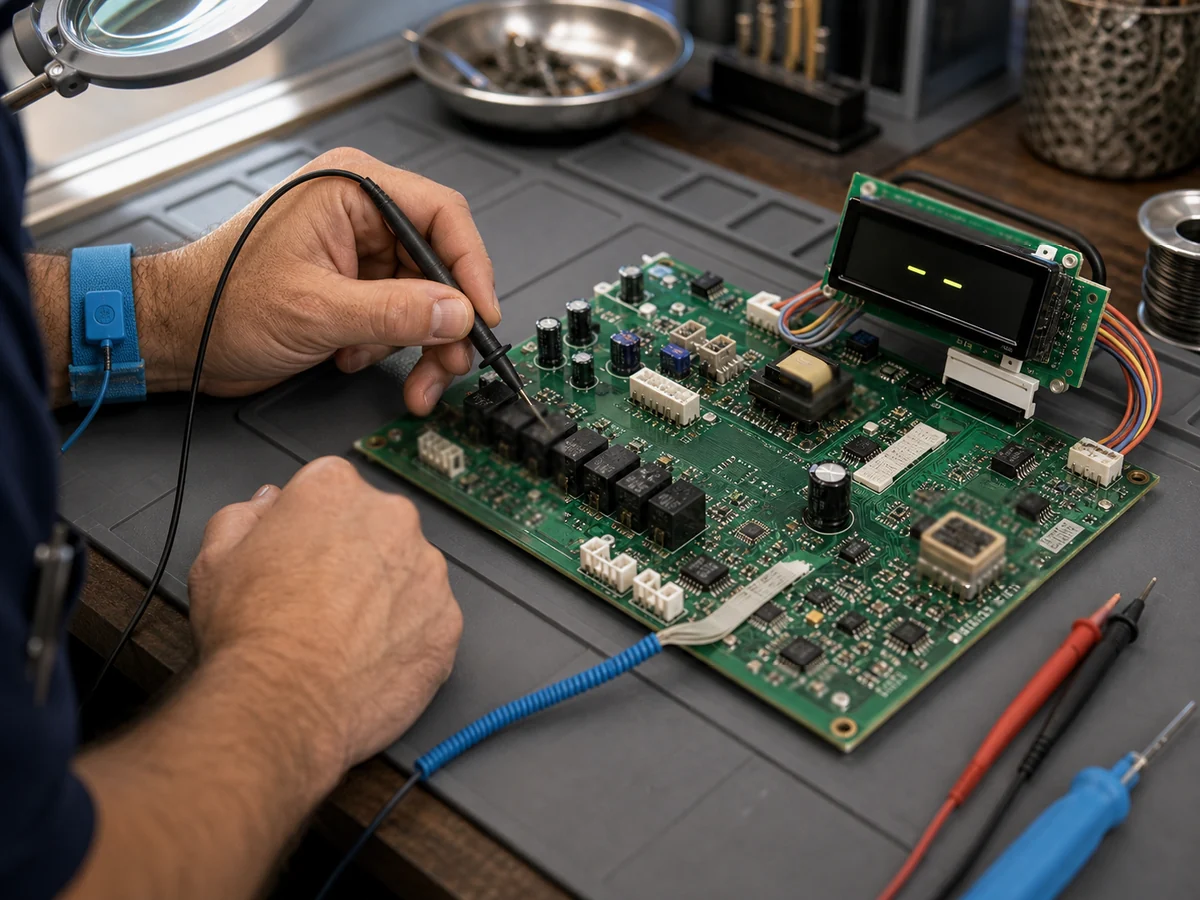
The electronics are the story. Where a 500 series used mechanical controls, the 600 reads cabinet temperature through thermistors and governs everything from a control board — a board that, across the run, Sub-Zero revised through three distinct generations. That sophistication is also the soft spot: most 600 series calls in 32082 are electronic before they are mechanical.
The Failures That Define a 600 Series Call
Control-board and EEPROM faults
The signature symptom is a display showing double dashes. That is a failed EEPROM — the board has lost its ability to hold settings, and no reset recovers it. Replacement is the fix, and the right board is dictated by the serial-number generation, not the model alone. Some 600 boards are now rebuilt-only, which is precisely why we confirm the part before the visit rather than during it.
The vacuum-condenser warning
On 1998–2002 boards, a “Vacuum Condenser” message flags excessive compressor run — almost always a condenser choked with dust or, on coastal streets, salt-borne grime. The cure begins with a vacuum cleaner and a deep coil cleaning; run times drop and the message clears. We treat it as a maintenance finding first and a board question only if it persists.
Thermistor and evaporator-fan failures
A drifting thermistor mis-reports cabinet temperature and trips the service light for no visible reason; a seized fresh-food evaporator fan leaves the freezer solid while the refrigerator warms. Both are discrete, affordable parts and frequent single-visit repairs. When the fresh-food side is the one in trouble, the refrigerator repair line covers the broader diagnosis.
600 Series Faults, First Checks, and Cost Lanes
| Symptom | First check | Cost lane |
|---|---|---|
| Display shows double dashes | Board generation against serial number | $700–$1,100 |
| Vacuum-condenser warning | Condenser cleaning, then run-time check | $250–$550 |
| Service light, temps wandering | Thermistor readings vs actual cabinet temps | $550–$900 |
| Fridge warm, freezer solid | Fresh-food evaporator fan | $550–$1,100 |
| Runs constantly, partial frost on coil | Gauges on the sealed system | $1,500–$3,000 |
One line, one technician, no dispatch queue
(904) 902-0927Why Part Revisions Are the Whole Game
More than any other series, the 600 punishes guesswork on parts. Sub-Zero split it into three electronic generations — broadly, units before serial #1810000, then two later revisions — and changed boards, fan assemblies and valves repeatedly within those. A board pulled for a 632 will not necessarily run a 650 or a 661, and a generalist who orders off the model number alone returns with the wrong box and bills you for the second trip.
Our discipline is dull and effective: read the full model and serial, confirm the generation, source the exact revision before we arrive. For Sawgrass and Players Club kitchens full of 600 series units, that one habit is why our repairs close in a single visit — the Sawgrass not-cooling notes show how it plays out address by address.
The 600 Series Model by Model
The 600 family spans several cabinet styles built across overlapping years. Pinning your exact model is the first half of pinning the right part; the serial number is the second.
| Model | Configuration | Build years |
|---|---|---|
| 632 | 48-inch side-by-side | 1996–2008 |
| 642 | 42-inch side-by-side | 1996–2008 |
| 650 | 36-inch over-under | 1996–2008 |
| 661 | 36-inch bottom-drawer | 2003–2008 |
| 690 | 48-inch side-by-side with dispenser | 1996–2004 |
| 601R / 601F | All-refrigerator / all-freezer columns | 1996–2009 |
The Three Board Generations, and Why They Matter
The single most important fact about a 600 series repair is which electronic generation the unit belongs to — it decides the board, and the board decides the repair. Serial #1810000 is the dividing line we read off the tag.
| Generation | Identified by | Board availability today |
|---|---|---|
| 600-1 (earliest) | Serial below #1810000 | Mostly rebuilt-only; sourced ahead of the visit |
| 600-2 (middle) | Later serial, 1998–2002 boards | Carries the “vacuum condenser” warning logic |
| 600-3 (latest) | Highest serials, into 2008–2009 | Best supported; new or rebuilt depending on model |
Reading the 600 Series Display and Warnings
The 600 series talks through its panel, and learning to read it saves a misdiagnosis. Here is what each display state actually means before a meter confirms it.
| What the panel shows | What it means | The fix it points to |
|---|---|---|
| Double dashes “--” | Failed EEPROM on the control board | Board replacement, serial-matched |
| “Vacuum Condenser” warning (1998–2002) | Excessive compressor run from a choked condenser | Deep coil cleaning first; board only if it persists |
| Service light, temperatures wandering | Thermistor drifting and mis-reporting | Sensor replacement against an actual cabinet read |
| Ice maker fault flagged | Fill solenoid energized too long on scaled water | Descale and valve service before the board |
What the Visit Walks Through on a 600 Board Call
A double-dash display is the most common 600 series call, and rushing to a board is the most common way to get it wrong. This is the order the visit follows in 32082.
- Confirm the generation from the serial The serial number against #1810000 names the board revision; ordering off the model alone is the coin flip that costs a second trip.
- Rule out the cheaper causes A vacuum-condenser warning starts at the coil, not the board; a wandering temperature starts at the thermistor. The board is confirmed, not assumed.
- Source new or vetted-rebuilt Where a new board still exists it is preferred; where the revision is rebuilt-only, we source from rebuilders who match your exact generation.
- Test the board in the unit The replacement is run in the cabinet and the temperatures verified over the 24-hour stabilization window before the repair is called done.
Owners Ask
600 Series Questions We Hear Most
My 650 display shows two dashes — what is it telling me?
A double-dash "--" reading is the 600 series way of reporting a failed EEPROM on the control board: the board can no longer hold its settings, and it has to be replaced rather than reset. There is no temperature or button trick that recovers it. We confirm the board generation against your serial number first, because the right revision is not interchangeable across the series.
What is the "vacuum condenser" message on my 600 series unit?
On boards from roughly 1998 to 2002 the "Vacuum Condenser" warning means the compressor has been running excessively, usually because the condenser is choked with dust or salt-borne grime and cannot shed heat. Nine times out of ten the fix begins with a thorough condenser cleaning. We clear it, verify run times drop, and only investigate further if the message returns.
The freezer is fine but the refrigerator is warming — is that the compressor?
On the 600 series that pairing usually points to the fresh-food evaporator fan, not the compressor. The two compartments share cold but move it with separate fans, so a seized refrigerator-side fan leaves the freezer solid while the fresh food creeps up. It is a discrete part and often a single-visit fix. We test the fan and read the coil before quoting anything larger.
Why does my technician insist on the serial number before ordering a part?
Because the 600 series changed constantly. It ran from 1996 to 2009 across three electronic generations split on either side of serial #1810000, with dozens of part revisions in between — boards, fans and valves that fit a 632 may not seat in a 650 or 661. The serial number names the exact revision, and naming it is the difference between one trip and three.
Is a rebuilt control board as good as a new one for a 600 series?
For the later 600 boards that Sub-Zero no longer makes new, a properly rebuilt board is the realistic path and a sound one — the common failure point is the EEPROM and supporting circuitry, which a competent rebuild addresses. We source from rebuilders who match your exact revision and we test the board in the unit before calling the repair done. A new board is preferable where one still exists; a vetted rebuild keeps an otherwise excellent 650 or 661 in service when it does not.
My 632 ice maker stalls and the board faults — are the two related?
Often, yes, and it is a known 600 series quirk. The ice maker’s fill solenoid is monitored by the board, and on these units a solenoid energized beyond about fifteen seconds — typically because hard-water scale is choking the fill — can register as a fault. So the cure usually starts at the water inlet valve and screen, not the board. We descale and test the fill timing first; replacing a board for what a valve caused is the kind of mistake serial-matched diagnosis avoids.
Does the 600 series suffer the same post-outage board failures as the BI built-ins?
It is vulnerable, though the BI brownout lock is its own specific signature. The 600 series board is electronic and just as exposed to a restoration surge after a Northeast Florida storm, so a unit that goes blank or erratic right after power returns may well have taken a hit. Because several 600 boards are now rebuilt-only, a surge loss here is costlier to source than on a newer unit — which is exactly why we recommend whole-home surge protection for any kitchen still running 600 series electronics.
Is a 661 bottom-drawer harder to service than a 650 over-under?
Different, mostly in the freezer. The 661 ran latest in the line, 2003 to 2008, and uses drawer slide hardware, drawer seals and duct arrangements the over-under 650 never had, so freezer-side work involves parts specific to the drawer design. Its electronics and board logic sit in the same family as the rest of the 600s, so the EEPROM and thermistor diagnosis is identical. We confirm the exact model before ordering, since a 650 part will not always seat in a 661.
Arrange a Visit to Your Kitchen
Telephone hours run Monday through Saturday, 7:30 to 6:30. Same-week appointments across 32082, gate access arranged in advance.