Model · Built-In Series · 2008–2022
Sub-Zero BI Built-In Repair in Ponte Vedra
These units fail by electricity more than by wear — and on this coast, the electricity arrives with the storms.
Sub-Zero Repair Ponte Vedra repairs Sub-Zero Classic Built-In (BI) refrigerators — the 2008–2022 BI-30U through BI-48 range — across Ponte Vedra Beach and the 32082 ZIP; call (904) 902-0927 or book online. Their defining failure is electronic: a restoration surge after a Northeast Florida storm locks the control board, leaving lights on and the panel dead. A surge protector prevents the repeat.
For Sub-Zero repair across Ponte Vedra Beach — Sawgrass, Marsh Landing and the oceanfront — call (904) 902-0927 or Book online.
What You Own
The Built-In Range and How It Differs
Sub-Zero® built the Classic Built-In line from 2008 to 2022 — BI-30U, BI-36R and BI-36F, the BI-36U and french-door BI-36UFD, the BI-42S and BI-42SD, and the BI-48S and BI-48SD, with flush, overlay and stainless suffixes. They arrived in the remodel wave that reworked many Ponte Vedra kitchens after 2008, and a large share are now passing the ten-to-fifteen-year mark where built-ins first demand real service.
The difference from the older classics is the control architecture. A BI runs everything through a board and reads temperature electronically, which makes it precise and quiet — and vulnerable to the one thing this coast produces in abundance: power surges. Where a 500 series fails mechanically and slowly, a BI tends to fail electrically and all at once, usually the morning after a storm.
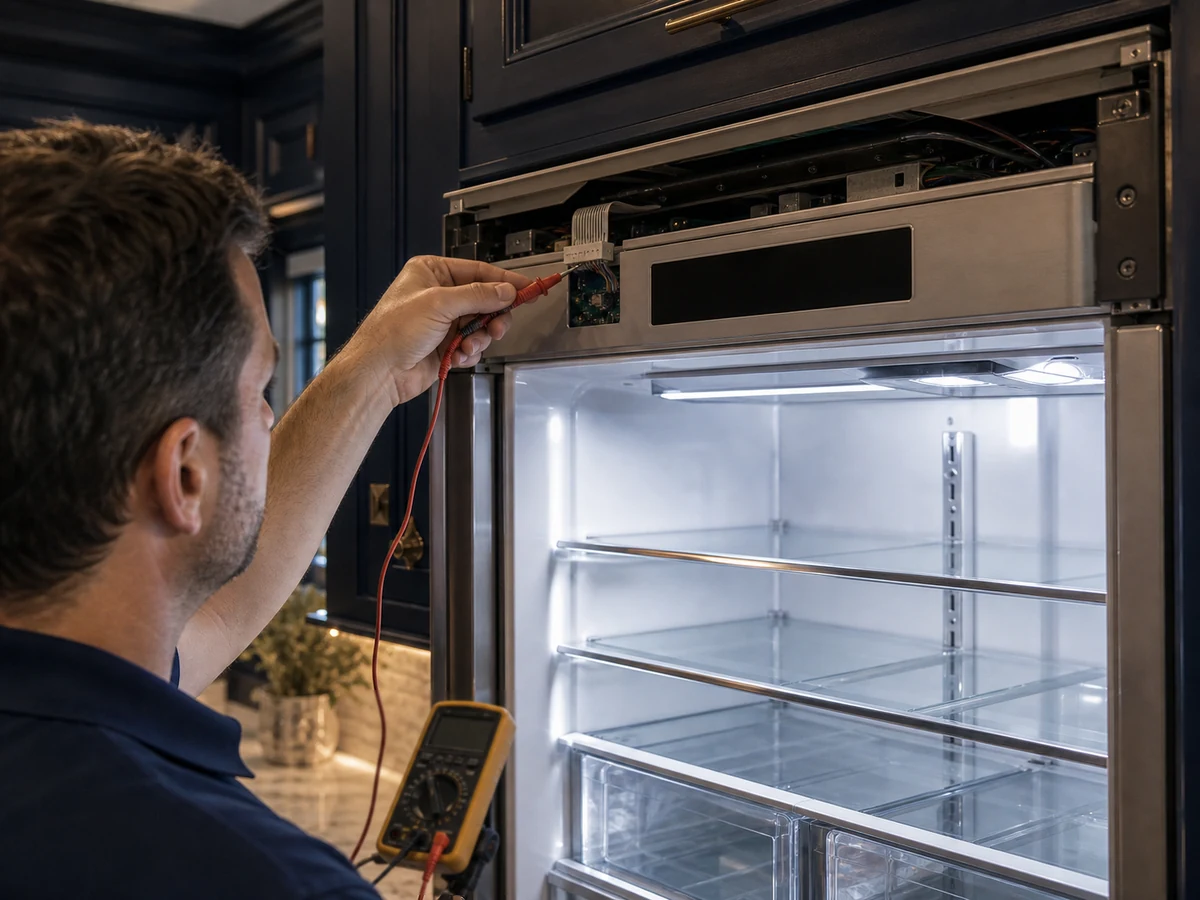
The Failures That Define a BI Call
Post-outage brownout board lock
This is the headline. When the grid restores after an outage, voltage can jump fifty to a hundred percent over nominal for an instant, and the control board takes the surge rather than the compressor. The result is a board in brownout lock: interior lights on, panel dark and unresponsive, compartments slowly warming. The board usually needs replacing — and a whole-home surge device, covered in the coastal care guide, keeps the next storm from doing it again.
EC50 and EC40 codes
These flag excessive compressor run — EC50 on the refrigerator side, EC40 on the freezer. The cause is usually a dirty condenser or a torn gasket, not a dying compressor, so we inspect those first. On coastal streets the condenser fills with salt-borne grime faster than inland, which is why these codes appear here more often than the inland norm.
Water inlet valves and defrost components
The ice maker draws through a water inlet valve whose solenoid wears and whose screen scales shut in our very hard water — a contained repair that leaves the rest of the unit untouched. Defrost heater and thermostat failures ice the evaporator over time, and a condenser-fan triac on the board can fail and mimic a cooling problem. Each is a distinct diagnosis, not a single guess.
BI Symptoms, First Checks, and Cost Lanes
| Symptom | First check | Cost lane |
|---|---|---|
| Lights on, panel dead after a storm | Control board for brownout lock | $700–$1,300 |
| EC50 or EC40 code | Condenser cleaning, then door seals | $250–$700 |
| Ice maker stalled, fridge fine | Water inlet valve and screen | $300–$650 |
| Evaporator icing, uneven cooling | Defrost heater and thermostat | $550–$1,100 |
| Cooling loss, condenser fan idle | Condenser-fan triac on the board | $550–$1,100 |
One line, one technician, no dispatch queue
(904) 902-0927The Surge Problem Is a Ponte Vedra Problem
Northeast Florida leads the country in cloud-to-ground lightning, and coastal St. Johns County loses power the way the whole region does — briefly, often, and mostly in the summer storm season. After Matthew in 2016 and Irma in 2017 we worked board-replacement calls in this ZIP for weeks, and every named-storm brush since has produced a smaller echo of the same wave. The built-ins are the units that absorb it.
So the BI conversation always ends with prevention. A whole-home surge protector at the panel is a few hundred dollars installed against a four-figure board, and for an estate running multiple built-ins the math is not close. When a unit does come back warm after an outage, give it the 24-hour recovery window, then start with the not-cooling rundown before you assume the worst.
The Built-In Range by Configuration
The BI line covered every cabinet width and door style across fourteen years. The base model and width set the refrigeration parts; the suffix sets the door parts.
| Model | Configuration | Notes |
|---|---|---|
| BI-30U | 30-inch over-under | The compact built-in of the line |
| BI-36U / BI-36UFD | 36-inch over-under / french-door | FD adds twin fresh-food doors |
| BI-36R / BI-36F | 36-inch all-refrigerator / all-freezer | Often installed as a paired column set |
| BI-42S / BI-42SD | 42-inch side-by-side / with dispenser | SD adds the through-door dispenser path |
| BI-48S / BI-48SD | 48-inch side-by-side / with dispenser | The widest built-in; heaviest doors |
What to Do When a BI Goes Dark After a Storm
The hours after a restoration surge decide how much of the contents you save and how cleanly we can diagnose the board. This is the order we ask owners to follow before we arrive.
- Confirm it is the unit, not the circuit Check the breaker and the GFCI; a tripped circuit mimics a dead board and is the easiest thing to rule out first.
- Give it the recovery window If power has only just returned and the panel responds, allow the 24-hour stabilization period before judging whether it is recovering.
- Note the exact symptom Lights on with a dark, unresponsive panel is the brownout-lock signature; a blank display with everything else off is a different, simpler power question.
- Protect the contents Keep the doors shut; a closed built-in holds temperature for hours, and the less it is opened the more survives until the visit.
- Book with the model and serial Read the tag to us so the correct board generation is confirmed and the part rides out on the first trip.
Reading a BI Model Number, Suffix by Suffix
A BI model number packs the cabinet size and the door style into a short string, and knowing how to read it tells us which parts track the base model and which track the door. Here is the decoder.
| Element | What it tells us | Which parts it governs |
|---|---|---|
| The number (30 / 36 / 42 / 48) | Cabinet width in inches | Refrigeration, board, evaporator, inlet valve |
| U / R / F / S / SD | Over-under, all-fridge, all-freezer, side-by-side, with dispenser | Sealed-system layout and dispenser path |
| FD | French-door fresh-food configuration | Twin doors, center mullion, mullion heater |
| /S, /O, /F (suffix) | Stainless, overlay panel-ready, brief 2008–2009 flush | Door and gasket parts, sized to that exact door |
The Surge-Protection Math for a BI Household
The BI conversation always returns to prevention, because the numbers are not close. A whole-home surge protector at the panel runs a few hundred dollars installed; a BI control board lost to a restoration spike runs $700–$1,300 to replace, and an estate kitchen running two or three built-ins exposes that many boards to the same storm. After Matthew in 2016 and Irma in 2017 we worked board-replacement calls in this ZIP for weeks — every one of them a failure a panel-level device would likely have stopped.
So we treat surge protection as maintenance rather than an upsell: a predictable Northeast Florida failure with a cheap, permanent fix. It belongs on the same calendar as quarterly coil care and gasket renewal, which the salt-air care guide lays out in full. A PRO 48’s dual-system electronics appreciate the same protection, covered on the PRO 48 page.
Owners Ask
Built-In Questions from Storm Country
After the power came back, the lights work but the panel is dead — what happened?
That is the classic BI brownout lock. The damage rarely comes during the outage; it arrives at restoration, when voltage can spike well past nominal for an instant and the control board absorbs the hit. The board locks, the panel goes dark while interior lights stay on, and the compartments slowly warm. The board usually needs replacement, and a surge protector prevents the next one.
What do the EC50 and EC40 codes on my built-in mean?
EC50 flags excessive run time on the refrigerator side and EC40 on the freezer side. Most often the cause is mundane — a condenser matted with dust or salt grime, or a torn door gasket bleeding in warm air — not a failed compressor. We inspect the condenser and seals first and put gauges on the system only if those pass. Clearing the code without the cause just delays the next one.
My BI ice maker stopped but the refrigerator is fine — where do you look first?
On the built-ins the water inlet valve is the usual suspect. Its solenoid wears, and our very hard water scales the screen behind it, so fill slows or stops while the rest of the unit runs normally. We test the valve, descale or replace it, and check the fill timing. It is a contained repair that rarely touches the sealed system or the board.
Is whole-home surge protection really worth it for a Sub-Zero here?
In Northeast Florida, yes. We see more than a hundred thunderstorm days a year, and the restoration surge after each outage is the leading killer of BI control boards — a board replacement runs four figures, a whole-home surge device a fraction of that installed. For a household running two or three built-ins, the protection pays for itself the first storm season it earns its keep.
What do the suffixes like /S, /O, and FD mean on a BI model number?
They describe the door and finish, not the refrigeration. /S is stainless, /O is overlay for a panel-ready cabinet, and the brief /F flush option appeared only on 2008–2009 units. FD marks a french-door configuration, as on the BI-36UFD. The suffix matters for ordering a gasket or a door part, which is sized to that exact door, but the board, valves, and sealed-system parts track the base model and serial instead.
My BI is past fifteen years — is it heading for a wave of failures?
Not a wave, but a window. The 2008–2022 built-ins are precise machines whose mechanical parts are not the weak point; what ages is the board and the gaskets, plus an inlet valve scaled by hard water. A unit that has had its board protected from surges and its seals renewed on the coastal schedule commonly runs well past fifteen years. The honest risk is a single board hit from a storm, which surge protection largely removes.
The french-door BI-36UFD has condensation between the two doors — is that normal?
A little is, a lot is not. The BI-36UFD splits the fresh-food opening into twin doors with a center mullion, and in humid coastal air that mullion area can sweat slightly in summer — physics, much like a cold window. Persistent moisture, droplets running down the gap, or frost forming there points instead to a tired gasket on one of the two doors or a mullion heater that has failed. We check both seals and the heater circuit; on a french-door unit the door parts are sized to that exact configuration.
Are BI control boards still available, or are they getting scarce like the 600 series?
They are in much better supply than the 600 boards, since the BI line ran into 2022 and the parts catalog is still current for most revisions. That said, the right board tracks the base model and serial, not the door suffix, so we confirm the exact unit before ordering. The practical takeaway is the same either way: protect the board you have with a whole-home surge device, because a replacement — readily available or not — is a four-figure repair you can largely prevent.
Arrange a Visit to Your Kitchen
Telephone hours run Monday through Saturday, 7:30 to 6:30. Same-week appointments across 32082, gate access arranged in advance.